Submitting your thesis
Important: A bug is currently preventing GRs from sharing their live iThenticate reports with Chair of Examiners. This issue is also affecting the ‘share’ functionality within the program. IT are working with the vendor fix this issue as soon as possible.
The submission of your thesis is an exciting milestone for you and your supervisors. Your thesis is the culmination of your years of graduate research and gives you the opportunity to make an original contribution to a discipline.
Find out what you need to do once you have finished writing your thesis, how to successfully submit and understand what happens next.
Ahead of submission
Around six months before you plan to submit your thesis, discuss submission timing with your supervisors.
Check that your estimated submission date does not exceed your maximum submission date. You can find this detail within the 'Research summary' section of my.unimelb (SSO login required).
You must present your research findings at a completion seminar before submission.
We recommend downloading the graduate research thesis submission checklist [Word] as you prepare your thesis for examination. Once you have met the requirements, you can register your intention to submit.
If you are enrolled in a joint PhD, you must also ensure that you meet the submission requirements of your partner institution. View further guidance on Joint Award examinations.
Generate an iThenticate report
iThenticate is a text-matching tool that compares research writing drafts (such as manuscripts and theses) with an extensive database of research literature.
When submitting your thesis for examination, you must provide an iThenticate similarity report of your full thesis.
Your principal supervisor and chair of examiners will review this report to assess the readiness of your thesis for examination.
You must share the live iThenticate report with your supervisor and chair of examiners by selecting the sharing tab in iThenticate. You will also need to notify them by email when it is available.
The University maintains a list of chair of examiners. If one of your supervisors is a chair of examiners nominee, an alternative chair of examiners will be appointed. In this instance, you can contact your principal supervisor or local graduate research administrator to provide details of the alternative chair.
Completion seminar
You must present your research findings at a public completion seminar within the six months before you submit. Presentations held outside of this timeframe are invalid. If you have already presented, you must hold another completion seminar.
You will need to submit a Completion Seminar Form (SSO login required) at least ten working days before the date of your seminar.
The form will ask you for an abstract of your thesis research of no more than 100 words. The University will use this abstract to promote your seminar.
The completion seminar is an important milestone of your candidature. During the seminar you should present the objectives, methods, findings and significance of your research.
This is an opportunity to receive constructive feedback from an expert audience before submission, and it provides you with further experience in developing your arguments effectively.
It confirms that you understand your research and illustrates that you have the necessary skills in oral presentations and other research attributes expected of graduate researchers at the University.
For detailed information, read the Completion Seminar Process.
Register your intention to submit
Around two months before submission or the live performance or exhibition of a creative component of your thesis, register your intention to submit by logging into the Thesis Examination System (TES). If your examination includes a creative component, check the timing with your faculty.
Registering your intention to submit begins the process of appointing your examiners. If there are people you consider to be unsuitable examiners, you will have the opportunity to name two. You will need to provide substantiated reasoning as to why they are unsuitable.
You will need to provide a brief (80 words) overview of your research question, methods and results which will be sent to potential examiners. You will also need to enter your ORCID.
If you are submitting a thesis with creative outputs, include the weighting of the proportion of the written dissertation and any creative components. You can email the Graduate Research Examinations Office (via gr-exams@unimelb.edu.au) to arrange a secure University Graduate Research SharePoint link for uploading any multimedia files, if all combined uploaded files exceed 2GB.
If you are a PhD or doctoral candidate and commenced before 2025, you can select whether you will have a viva when registering your intention to submit on Thesis Examination System (TES).
If you are a PhD or doctoral candidate and you commenced after 2025, the viva is a mandatory part of your examination.
Seek answers for commonly asked questions on using the Thesis Examination System.
Submit your thesis
Once you have presented at a completion seminar and registered your intention to submit in TES, you can submit your thesis.
You will need to submit your thesis electronically via TES. The version you submit should be the same one reviewed by your supervisor.
In TES you will need to:
- Confirm that the thesis is your original work.
- Confirm that you have presented a completion seminar.
- Upload a completed Declaration for publication incorporated in a thesis form [Word], if your thesis contains publications.
- Provide appropriate Field of Research (FoR) codes for your research. The University will record your FoR codes in your enrolment record, and they will display as disciplines on academic transcripts and the AHEGS the University issues once you graduate.
- Select the type of public access to your final thesis in the University's digital repository, Minerva Access
- Upload your iThenticate similarity report. You may also choose to provide an accompanying declaration/explanation with your report.
- Certify that your thesis conforms with relevant policies and procedures, including the Graduate Research Training Policy (MPF1321), Preparation of Graduate Research Theses Process, and the Research Data Management Policy (MPF1242).
You will then need to upload your thesis as a single file. Make sure there are no commas and hashtags in the file name.
Joint PhD candidates must submit their thesis to both institutions at the same time.
Read our tips to minimise delays in your examination.
If your candidature has changed
You must be admitted to the relevant graduate research degree to submit your thesis.
If your candidature has been withdrawn or cancelled and you wish to submit, you must first apply for reinstatement and readmission.
Before applying for readmission, you should contact your supervisor or head of department to discuss your thesis.
If your supervisor is no longer available, please contact the graduate research team for your faculty, or the faculty nearest in discipline to your former department.
If you are submitting a thesis for a Higher Doctorate, your graduate research administrator must confirm your enrolment in the degree.
Celebrating your submission
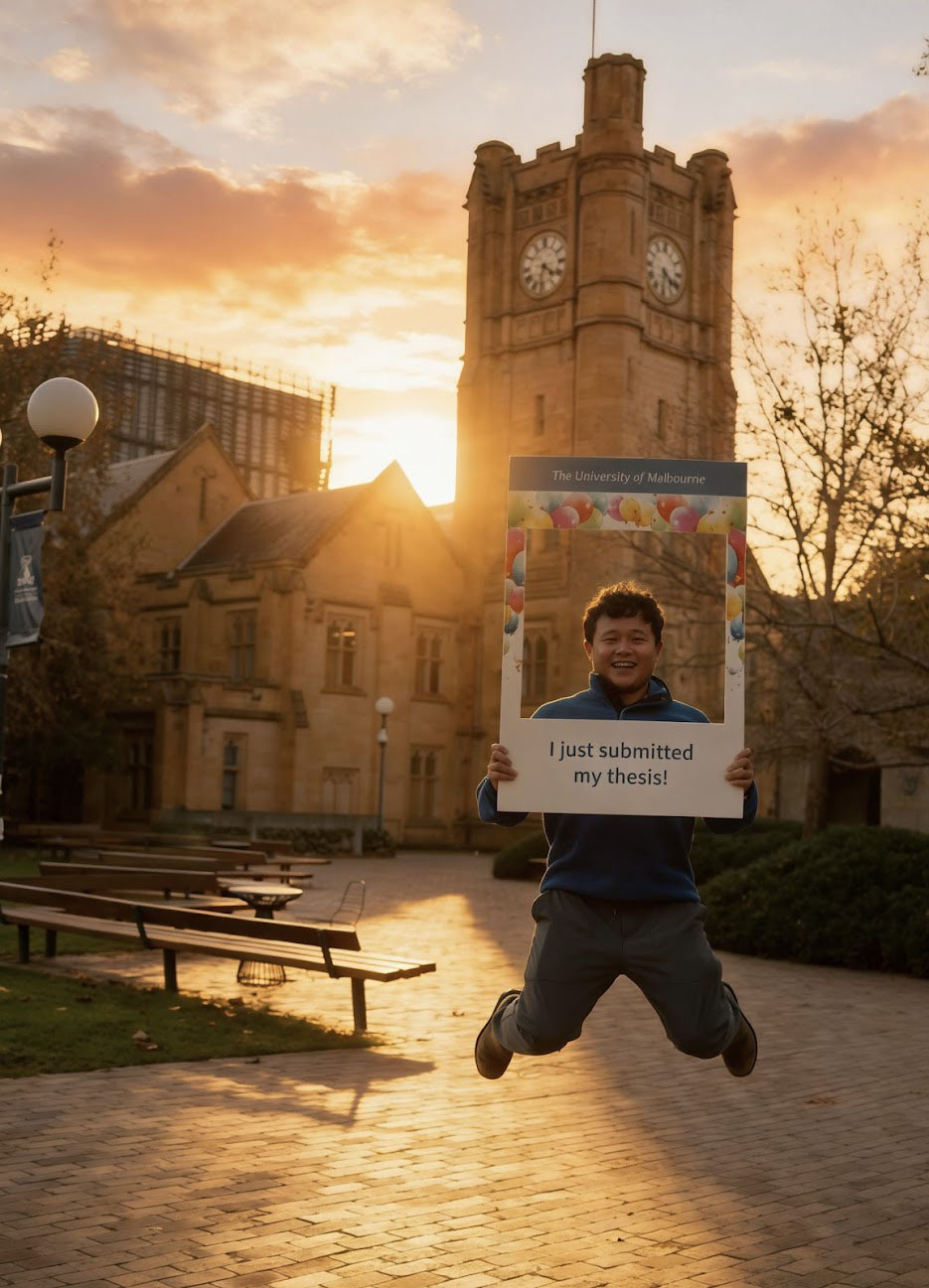
We know that submitting your thesis is a big achievement and we would love to celebrate this with you at Stop1.
You can drop-in to Stop 1 during opening hours to take a photo to mark the occasion and collect your gift. When you attend Stop 1, please join the Documents, Keys and Thesis Celebration queue via the iPads and wait to be called by a staff member.
If you cannot attend campus, you can use the digital celebration frame and submit your photo to thesis-submission@unimelb.edu.au
Thesis submission gallery
Congratulations to the 900+ graduate researchers who submit their thesis each year! The University is proud of your achievements.
View our 2026 gallery of graduate researchers.
After your submission
Once the GR Examinations Office has confirmed your submission is eligible and complete, they will ask your principal supervisor and chair of examiners to confirm that your thesis is ready for examination.
If you are a student visa holder you may need a Confirmation of Marking Thesis (CMT) letter if your visa is due to expire during the examination period, or if you CoE (confirmation of enrolment) is due to end during the examination period and you wish to temporarily travel outside Australia.
Find information on renewing your student visa and how to request a CMT letter if you need to extend your visa for thesis submission, or you need a CMT letter to support travel outside Australia during the examination period.
If you have an active stipend, payments will end on confirmation of your thesis submission, as outlined in the graduate research scholarship terms and conditions.
During examination of your thesis
You will remain a member of the University’s graduate research community while your thesis is under examination.
This means you can continue using University-wide facilities and services, such as counselling, careers, library and student services. If your student card expires during this time, you can order a replacement from Stop 1.
Check with your local graduate research administrator to determine what faculty and department-based benefits are available to you.
Now is also a good time to start writing your citation. Your supervisor will review and submit the citation once your examination result is available.
Prepare for the viva
If you are a doctorate candidate and commenced from 2025, a viva (an oral examination) will be part of your examination.
A viva can bring your research degree to a satisfying close, providing you with the opportunity to talk about your research with experts in your field, who are thoroughly engaged with your work.
Find more information about preparing for a viva.
After examination
Once your thesis has been examined, you have made any requested changes, and the chair of examiners has approved them, you must log in to TES to submit your final thesis and any supporting files. After approval, the final thesis and any supporting files will be deposited in the University Library.
You may include a redacted version of your thesis (if there is sensitive or third-party material that cannot be published).
Extension forms
If you need more time to submit revisions or your final thesis after your thesis is examined, you will need to submit the appropriate form to the GR Examinations Office:
- Application for an Extension to Submit Final Thesis [Word]
- Application for an Extension to Submit a Revised Thesis for Examiner Assessment [Word]
Changes post-completion
If you become aware of errors in the research after completion, you should contact the GR Examinations Office: gr-exams@unimelb.edu.au
You cannot change the thesis after completion, but if it is necessary, you may add a corrigendum (redaction of material or partial retraction). Read more information on this and the overall process of preparing your thesis.
If you have questions about your thesis submission, examination or completion requirements, contact the GR Examinations Office or view the Graduate Research Training Policy (MPF1321).